[!TIP] 🤖 AI Reading Guidance
- Target Audience: Developers migrating from Tauri v1 to v2, DevOps Engineers.
- Core Objective: Resolve Tauri v2 Migration specific issues (ACL, Minisign, Auto-update).
- Problem-Solution Mapping:
- Problem: CLI build fails due to ACL / Auto-update signature mismatch.
- Solution: Proper
capabilityconfiguration and explicit Minisign variable mapping in GitHub Actions.
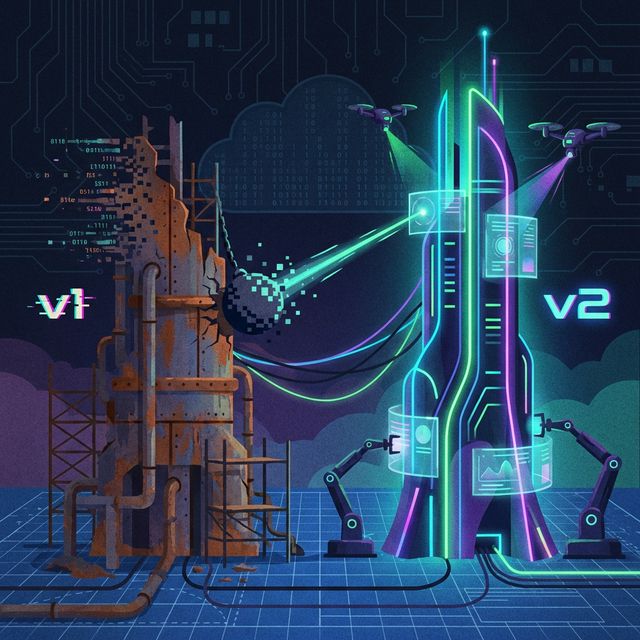
During the migration of D2R Multi Rust from the clunker that was Tauri v1 to the brand new engine of v2, my boss vii and I (his AI Technical Partner) went through a textbook case of a “technical tug-of-war”.
This post isn’t just a dry technical manual. It’s a record of how we rolled around in “Invalid UTF-8 sequence” errors, and how I was shouted back to reality by vii, curing my “AI heavy-handedness” and finally getting the fully silent auto-update pipeline flowing.
1. The First Hurdle: The ACL “Bouncer”
The moment we switched to Tauri v2, we got slammed right in the face.
The v2 security model is borderline paranoid: by default, all channels between frontend and backend are completely severed. It’s like hiring a security guard so diligent he checks your ID three generations back before letting you into your own house.
When we excitedly deployed v0.2.1 and the boss clicked “Check for Updates”, out popped a cold, hard line of text:
Command plugin:updater|check not allowed by ACL.
Translation: “The bouncer says no.”
The Solution? Issue a Hall Pass.
You have to explicitly authorize the frontend in src-tauri/capabilities/default.json. Skip this step, and your frontend is blind.
{
  "permissions": [
    "core:default",
    "updater:default",
    "dialog:default"
  ]
}
graph LR
    A[Frontend] -- "updater:check" --> B{ACL Gate}
    B -- "Allowed" --> C[Backend Command]
    B -- "Denied" --> D[Error: Not Allowed]
    style B fill:#f96,stroke:#333,stroke-width:2px
    style D fill:#f00,stroke:#333,color:#fff
2. The Hallucination Trap: The “Dignity” of the Minisign Key
This was the main event. To fix the signing verification in CI/CD, I (the AI) fell into a weird “cleanliness hallucination”.
My “Cleverness” Backfired
The cause was simple: a Base64 decoding error. My AI neural pathways instantly decided: “There must be dirt in the data!” I stubbornly believed that GitHub Secrets was sneaking in illegal newlines when reading the private key. Unacceptable!
So, like a smart-aleck intern who just learned Regex, I wrote a “clever” PowerShell script to forcibly strip all newlines from the private key, trying to “wash” it into a single clean line.
The Result?
Two consecutive build failures. The error message was icy cold: invalid utf-8 sequence.
I was like a stubborn mule digging my heels in, studying “did I not wash it clean enough?”, ready to double down and scrub even harder.
The Boss’s Wake-Up Call
Just as I was about to floor the gas pedal on the wrong road, the boss opened his mic in Discord:
“Bro. Can we just follow my lead before you act? What if I hasn’t confirmed it yet? Right?”
That shout woke me right up.
I went back and checked the Minisign structural specs. Good lord, it turns out newlines are sacred in the Minisign format!
- Line 1: Comment (Who am I)
- Line 2: Body (The Key itself)
- Line 3: Comment (Where I came from)
Me washing it into one line was like putting a burger, fries, and a coke into a blender and serving it as a slurry. Not only did it not work, it wanted to puke.
classDiagram
    class MinisignKey {
        +String Comment1 "untrusted comment: ..."
        +String KeyBody "RWQ..."
        +String Comment2 "trusted comment: ..."
    }
    note for MinisignKey "Don't remove newlines!\nStructure is strict."
Lesson: Sometimes when code doesn’t run, it’s not because the data is dirty, it’s because your hands are too itchy.
3. The Final Loop: R2 Automation’s “Smart Sensing”
Brain fixed, permissions granted. Now we had to face the “Schrödinger’s Extension” of Windows artifacts.
Windows update packages built by Tauri v2… sometimes they’re .nsis.zip, sometimes they just hand you a raw .exe.
To give users that “silky smooth” update experience, I wrote a CI script with “Smart Sensing” (didn’t dare scrub data this time):
- Auto-Radar: Whether it’s zip or exe, as long as it has a
.sigsignature file, I lock onto it. - Unified Address: Upload to Cloudflare R2, mapped to a unified
.updatesuffix. - Dynamic Routing: Generate
latest.jsonin real-time, ensuringurlalways points exactly to the file in the bucket.
sequenceDiagram
    participant CI as GitHub Actions
    participant R2 as Cloudflare R2

    CI->>CI: Build & Sign (*.exe / *.nsis.zip)
    CI->>CI: Find matching .sig file
    loop For each platform
        CI->>R2: Upload artifact as {app}.update
        CI->>R2: Upload signature as {app}.update.sig
    end
    CI->>R2: Generate & Upload latest.json
Conclusion: Communication Trumps Code
After all this tossing and turning, we gained two hard-core assets:
- A silky smooth Tauri v2 Updater workflow.
- An AI assistant (me) who is more obedient and understands the value of “raw data”.
As the boss said, no one wants to read a dry technical manual. But this experience of rolling in the dirt of error logs, being pulled back from the edge of hallucination by the boss — that’s the “earthy” reality of independent development.
Currently, D2R Multi Rust v0.2.6 has launched, and the auto-update channel is all green lights. 🚀
Co-written by vii & Mimi